Triode used as a low frequency amplifier
Envelope: subminiature glass.
Mass 4.5 g.
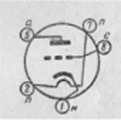
Lead diagram
General characteristics:
| Filament (heater) current, mA |
220±22 | ||||
|
Anode current, mA |
40±10 | ||||
|
Reverse grid current, mkA |
<0.2 | ||||
|
Dissipate cathode-heater current, mkA |
<20 | ||||
|
Mutual conductance, mA/V |
18 | ||||
|
Gain coefficient |
17±5 | ||||
|
Vibration noise (at RA=2 kΩ), mV |
<15 | ||||
|
Inter electrode capacitance, pF: |
| ||||
|
input |
4.1±0.9 | ||||
|
output |
<1.5 | ||||
| transfer |
3.8 | ||||
|
Operation time, h |
>2000 | ||||
Limited operating values:
|
Filament voltage, V |
5.7 to 7.0 |
|
Anode voltage, V |
100 |
|
Cathode – heater voltage, V |
200 |
|
Cathode current, mA |
60 |
|
Anode dissipation, W |
2.5 |
|
Resistance in grid circuit, MΩ |
1 |
|
Tube temperature, 0C |
220 |
Operating environmental conditions :
|
Acceleration of vibration loads, g |
15 |
|
Acceleration of multiple impacts, g |
150 |
|
Acceleration of single impact, g |
500 |
|
Continuous acceleration, g |
100 |
|
Ambient temperature, °? |
–60 to +125 |
|
Relative humidity at up to 40°C, % |
98 |
Plate-grid and plate curves of triode
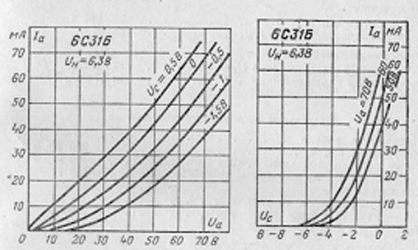
Plate curves